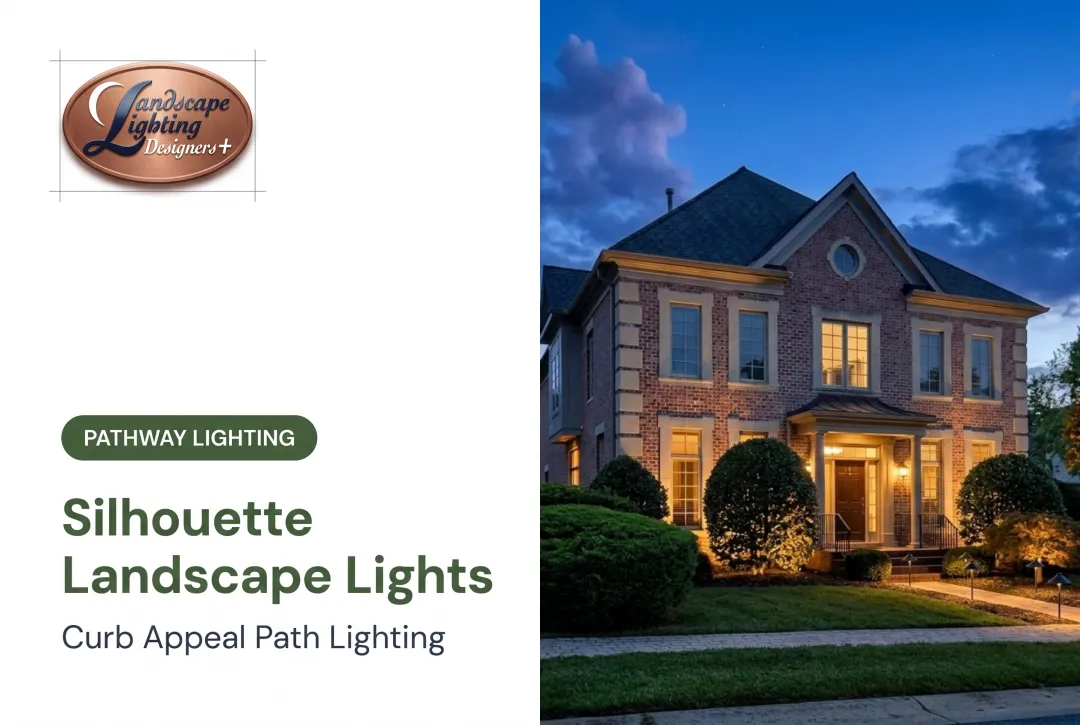
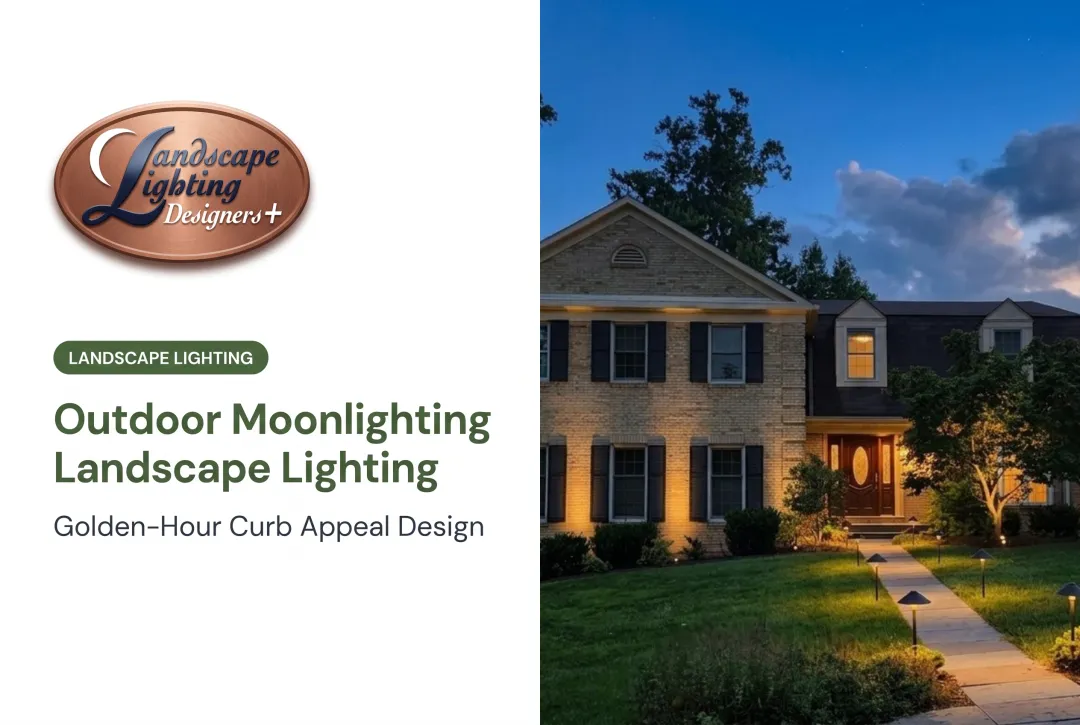
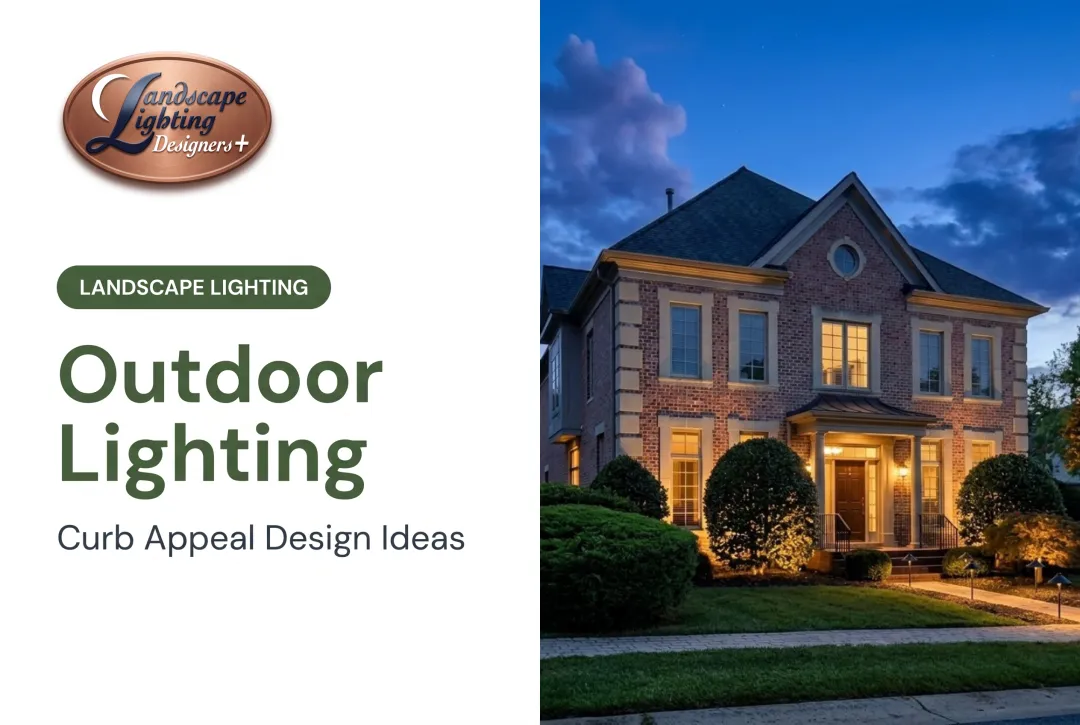
Professional outdoor curb appeal lighting solves this problem by strategically illuminating architectural details, mature trees, pathways, and entryways. According to the National Association of Home Builders' 2024 survey of more than 3,000 buyers, 82% rated exterior lighting essential or desirable—a clear signal that thoughtful nighttime presentation influences property perception and buyer appeal.
Key Takeaways
- Extends strong first impressions after dark and lifts perceived property value
- Improves pathway safety by revealing steps, grade changes, and obstacles
- Low-voltage LEDs cut energy use 80–90% vs. halogen and last 25,000+ hours
- Layers pathway, accent, and ambient light for depth without overlighting
- Fits DC Federal-style townhomes, Victorians, and mature tree canopies
Why Outdoor Curb Appeal Lighting Matters for DC Metro Homes
Nighttime first impressions shape property perception
Your home's curb appeal doesn't end at dusk. Guests arriving for dinner, neighbors walking dogs, and prospective buyers driving by all form impressions based on what they see after dark. A 2021 NAHB study found that 87% of buyers rated exterior lighting essential or desirable.
Well-executed lighting makes your home visible and creates a welcoming atmosphere that signals care and safety. In neighborhoods like Chevy Chase, Bethesda, and Potomac, architectural detail and mature landscaping define property character. Professional lighting keeps those investments visible after dark.
Safety and security through strategic illumination
Properly lit pathways, steps, and entries serve practical functions that protect residents and visitors:
- Fall prevention: The National Institute on Aging recommends stair lighting, motion-activated path lights, and porch lights to cut trip hazards
- Clear navigation: Illuminated walkways reveal grade changes, uneven flagstones, and obstacles that disappear in darkness
- Visible entries: Well-lit front doors and porches help guests identify the correct entrance and navigate steps confidently
- Perceived security: Lit entryways and paths signal occupancy and remove hiding spots (DarkSky International notes lighting alone is not a proven crime deterrent)

During DC's mild spring and fall evenings, thoughtful lighting also keeps patios, garden seats, and outdoor dining areas usable well past sunset. The landscape becomes living space you can actually use, not just scenery.
Special considerations for historic DC architecture
Federal-style townhomes, Victorian properties, and established neighborhoods throughout Georgetown, Capitol Hill, and Cleveland Park require restraint. Historic England's guidance recommends lighting only selected elevations or features, choosing meaningful nighttime viewpoints, concealing fittings, and avoiding permanent scarring of historic fabric.
Mature tree canopies, a defining feature of Bethesda, Potomac, and Chevy Chase streets, need designs that work with existing growth. Uplighting specimen trees from below and moonlighting from high-mounted fixtures build natural-looking layers that fit the property's character.
Essential Curb Appeal Lighting Techniques That Transform Properties
Pathway and entry lighting
Illuminating the journey from street to front door forms the foundation of curb appeal lighting. Kichler recommends spacing path lights 10–14 feet apart with 85–150 lumens per fixture, though actual placement depends on fixture photometrics, mounting height, and path geometry.
Effective pathway designs:
- Stagger fixtures along curved walks to avoid a rigid "runway" appearance
- Position lights to reveal steps, grade changes, and surface transitions
- Use downward-facing, shielded fixtures that illuminate the ground plane without creating glare
- Consider recessed step lights for built-in stone or brick staircases
For compact DC row houses and townhomes, even a simple three-fixture system can dramatically improve nighttime visibility and create visual depth where space is limited.
Architectural accent lighting
Grazing and uplighting techniques emphasize texture and dimension in columns, cornices, brick patterns, and decorative trim. Place fixtures close to textured walls and aim upward at low angles to reveal depth; position lights farther away for broader wall-washing effects.
Choose focal points deliberately:
- Federal-style townhomes: Highlight Flemish bond brickwork, fanlights, and cornice details
- Colonial homes: Emphasize symmetrical columns, pedimented doorways, and shutters
- Victorian properties: Accent bay windows, decorative brackets, and multi-color masonry
- Modern designs: Use clean downlighting to showcase geometric forms and material contrasts
Avoid illuminating every elevation equally. Select the viewpoints that matter most, typically the street-facing façade and main entry, and leave secondary walls in subtle shadow to create visual hierarchy.
Landscape and tree lighting
Uplighting specimen trees, foundation plantings, and garden beds add dramatic depth. Position fixtures at the base of mature tree trunks and aim upward to reveal bark texture, branching structure, and canopy form.
For established DC neighborhoods with towering oaks, maples, and magnolias, moonlighting offers a softer alternative. Fixtures mounted high in the canopy cast dappled light downward, mimicking natural moonlight and throwing organic shadows across lawns and pathways.
Tree lighting guidelines:
- Use standoff junction boxes and movable attachments to accommodate growth
- Leave approximately 2 inches of clearance where branches contact fixtures
- Avoid excessive output that unbalances the overall scene
- Combine uplighting and moonlighting for layered canopy effects
Foundation plantings benefit from subtle accent lights that graze foliage and reveal garden bed edges without overpowering the composition.

Driveway and motor court lighting
Long estate driveways require a cohesive visual sequence from the road to the entrance. Options include:
- Low-profile bollards: Short post fixtures along driveway edges provide wayfinding without obstructing vehicles or creating glare
- Recessed in-ground lights: Border-mounted fixtures suit formal entries but require debris clearing and complicate relocation
- Downlighting from structures: Fixtures mounted on nearby columns, pergolas, or trees cast broad illumination across paving
Short residential driveways may need only entry-pillar lighting or a few pathway fixtures to define edges and guide safe parking.
Façade and wall washing
Wall-washing techniques create even illumination across garage doors, home exteriors, or decorative elements. Position fixtures to deliver broad, uniform coverage that minimizes hot spots and provides ambient glow. Used this way, wall washing supplies the ambient layer that ties accent and pathway lighting together without competing for attention.
Seeing the technique on a finished property makes the decision easier—our project gallery collects completed installations from homes around the DC metro area.
Choosing the Right Fixtures and Design Approach for Your Home
Low-voltage LED advantages
Low-voltage systems (typically 12V) offer several benefits over 120V line-voltage installations:
- UL-listed low-voltage equipment lowers wet-condition shock risk through limited power-unit output
- LED sources use 80–90% less energy than equivalent halogen systems
- Lower voltage supports subtler dimming and more precise beam shaping
- Reduced electrical code burden and simpler transformer-based distribution ease installation
Proper design still accounts for transformer capacity, cable gauge, run length, and voltage drop. Per Kichler's guidance, total fixture VA should stay within transformer wattage, cable runs often start on 12-gauge wire, and voltage at the farthest fixture should stay above 10V.
Fixture quality and weather resistance
Marine-grade materials, proper IP ratings for weather resistance, and solid warranties protect fixtures from corrosion and moisture year after year.
IEC 60529 IP codes use two digits: the first rates solid protection (0–6), the second rates liquid protection (0–9). IP ratings still don't replace U.S. wet-location UL listings, which remain the authoritative standard for outdoor line-voltage luminaires.
Quality indicators include:
- UL 1838 or UL 2108 certification for low-voltage landscape systems
- Durable housing materials that resist corrosion
- Sealed optics that prevent moisture intrusion
- Manufacturer warranties covering 5+ years

Color temperature and mood
DarkSky International's 2025 residential criteria cap CCT at 3000K, with shielding and uplight restrictions. Warm white (2700K–3000K) complements brick, wood, and traditional facades, creating a welcoming glow. Cooler temperatures suit contemporary architecture with metal, glass, and concrete finishes.
Consistency matters: mixing 2700K pathway lights with 4000K accent fixtures creates visual discord. Choose one color temperature and apply it across all zones unless you're deliberately using contrast for effect.
Design principles for cohesive results
Professional designs layer lighting types to create depth:
- Path and safety lighting for clear navigation
- Accent lighting with focused beams on key features
- Ambient lighting that adds soft background glow and ties the scene together
Avoid glare through proper shielding and placement. IES's 2024 framework emphasizes useful, targeted, no-brighter-than-necessary, controlled, and warmer-colored lighting where possible.
Craig Collins at Landscape Lighting Designers Plus treats each DC metro property as unique, letting the architecture, landscape, and homeowner's vision drive the plan instead of a standardized layout.
Common Mistakes That Undermine Curb Appeal Lighting
The stadium lighting problem
Overlighting creates a harsh, institutional appearance instead of an elegant ambiance. More light doesn't equal better design or greater security, as DarkSky research confirms. Select key viewpoints and features; historic-building guidance notes it's rarely necessary to illuminate every elevation.
The principle: Use the lowest useful output and allow shadows to create contrast and depth.
Fixture mismatching issues
Mixing different styles, finishes, or color temperatures produces visual chaos:
- Bronze path lights paired with stainless steel uplights
- 2700K warm white alongside 5000K cool white
- Traditional lantern-style fixtures competing with modern minimalist bollards
Choose a cohesive fixture family and stick with it across all zones.

Poor placement errors
Common placement failures:
- Fixtures aimed at windows, creating interior glare
- Lights pointed skyward, causing light pollution and skyglow
- Exposed sources that shine directly into sight lines
- Steps and paths left dark, creating trip hazards
Fairfax County's residential guidance requires full-cutoff, horizontal fixtures in covered cases and confines spotlights to intended objects. Some low-output single-family fixtures (1,500 lumens or less) are exempt from certain requirements, but exemption doesn't eliminate glare concerns.
Always inspect installations from neighboring viewpoints and adjust aiming to keep light within property boundaries.
Working With a Professional Lighting Designer vs. DIY Installation
What professional designers bring
Site analysis and custom planning:
- Evaluating architecture, landscape maturity, pathways, and focal features
- Identifying meaningful nighttime viewpoints
- Calculating transformer capacity and voltage drop across cable runs
- Balancing aesthetic goals with safety and functional requirements
Technical expertise:
- Knowledge of low-voltage wiring standards and proper fixture selection
- Understanding of photometrics, beam angles, and fixture aiming
- Familiarity with local regulations and HOA requirements
Artistic vision:
Strong professional design treats lighting as composition: balanced layers that highlight architecture and landscape without glare or hot spots. Designers like Craig Collins personally plan every project from consultation through installation, so the vision stays consistent and fixture aiming can be refined after dark.

Cost benchmarks for DC metro projects
National platforms offer useful planning benchmarks, though prices vary widely:
- Angi's 2026 data: Average $3,500; most projects $2,000–$6,000
- HomeAdvisor's 2026 survey: Average ~$4,000; professional projects $1,000–$7,500
These figures come from completed customer surveys nationwide. In the DC metro area, focused entry and pathway systems often start around $3,000, while whole-property designs that cover trees, architecture, and outdoor living areas can exceed $15,000.
Local pricing hinges on fixture count, property size, access and trenching, transformer capacity, controls, and warranty scope.
Request detailed quotes that specify deliverables, payment terms, timeline, warranty coverage, and maintenance programs.
When professional expertise is essential
DIY may be appropriate for:
- Simple path lighting on small, flat properties
- Homeowners with electrical experience and access to quality fixtures
- Projects where subtle design refinement isn't critical
Professional design is essential for:
- Complex architectural lighting requiring precise aiming and balance
- Large properties with mature trees and multiple lighting zones
- Historic homes needing specialized techniques and preservation-sensitive approaches
- 120V work, in-ground fixtures, or installations requiring permits
- Designs subject to HOA, civic association, or local glare regulations
Angi recommends checking low-voltage licensing, insurance, bonding, and portfolio work viewed after dark. Look for credentials such as AOLP's CLVLT or COLD designations that indicate specialized training.
Homeowners who want certainty before installation can preview their home at night with an on-site demonstration.
Frequently Asked Questions
How do you illuminate a driveway?
Driveway lighting options include low-profile bollards along edges, recessed fixtures in borders, and downlighting from nearby structures. Long drives need a sequenced path of fixtures from road to entrance; short residential drives often need only entry-pillar or edge pathway lights for wayfinding without glare.
What is a driveway light called?
Common terms include bollard lights (short posts), path lights (low-profile fixtures), and recessed or in-ground lights. Designers pick by function and how well the fixture fits the architecture and landscape, not by generic labels alone.
What are the four main types of lighting?
Landscape designs typically layer ambient lighting (overall glow), task lighting (pathways and functional areas), and accent lighting (focal points). Path and safety lighting is usually a task application, not a separate fourth type. IES guidance stresses useful, targeted, controlled light that is no brighter than necessary and warmer-colored where appropriate.
What is the typical cost range for professional outdoor curb appeal lighting?
Professional installations typically range from $3,000 to $15,000+ based on property size, fixture quality, and design complexity. Smaller entry and pathway systems sit at the low end; full designs with trees, architecture, and outdoor living areas reach the high end. The 2024 NAHB survey found 82% of buyers rate exterior lighting essential or desirable.
How long does a professional landscape lighting installation take?
Most residential curb appeal projects take 1–3 days to install after the design consultation, depending on property size and complexity. Full timelines from contract to finish often land within about a week, but fixture count, trenching, tree work, and site access can extend that. Ask for a project-specific schedule in your contract.
Do landscape lights require much maintenance?
Quality LED low-voltage systems need little upkeep. ENERGY STAR explains that LEDs usually dim gradually over a rated life of about 25,000 to 50,000 hours rather than burning out suddenly. Plan on occasional lens cleaning, debris clearing, seasonal aiming tweaks as plants grow, and connection checks, or use a professional maintenance program.
Ready to transform your home's nighttime presence? Landscape Lighting Designers Plus offers complimentary, no-obligation design consultations for DC metro homeowners. Craig Collins personally designs every project, bringing 21 years of experience and an artist's eye to custom low-voltage LED installations throughout Bethesda, Potomac, Chevy Chase, Rockville, and Washington, DC. Contact us at (888) 582-8845 or contact@landscapelightingnow.com to schedule your consultation.