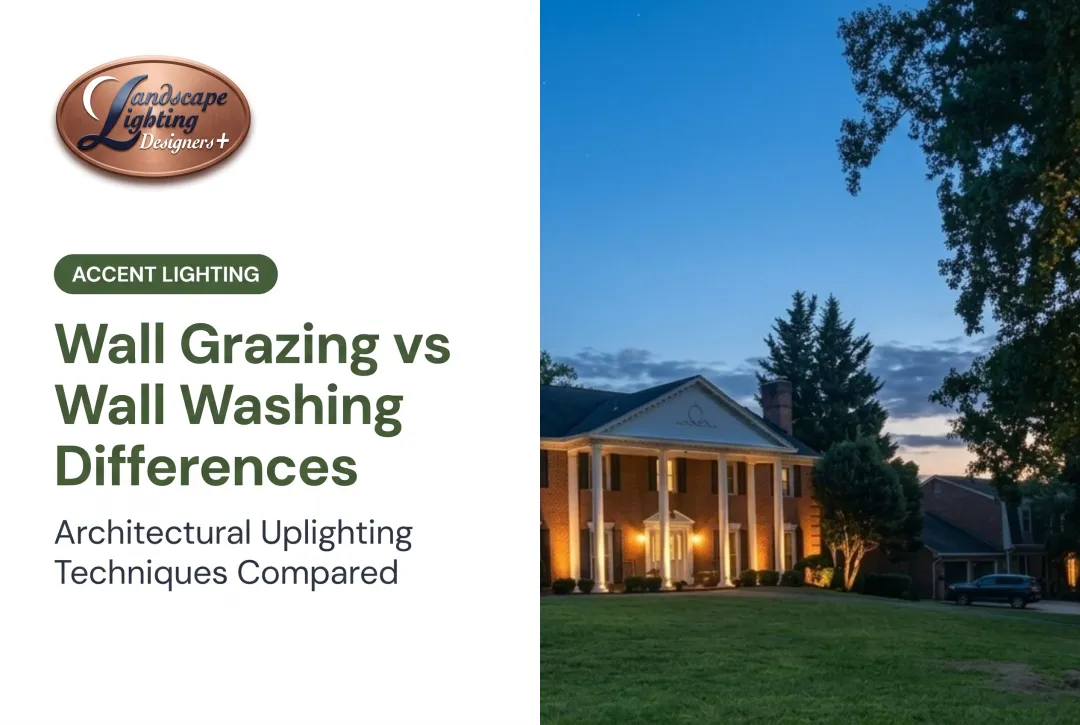
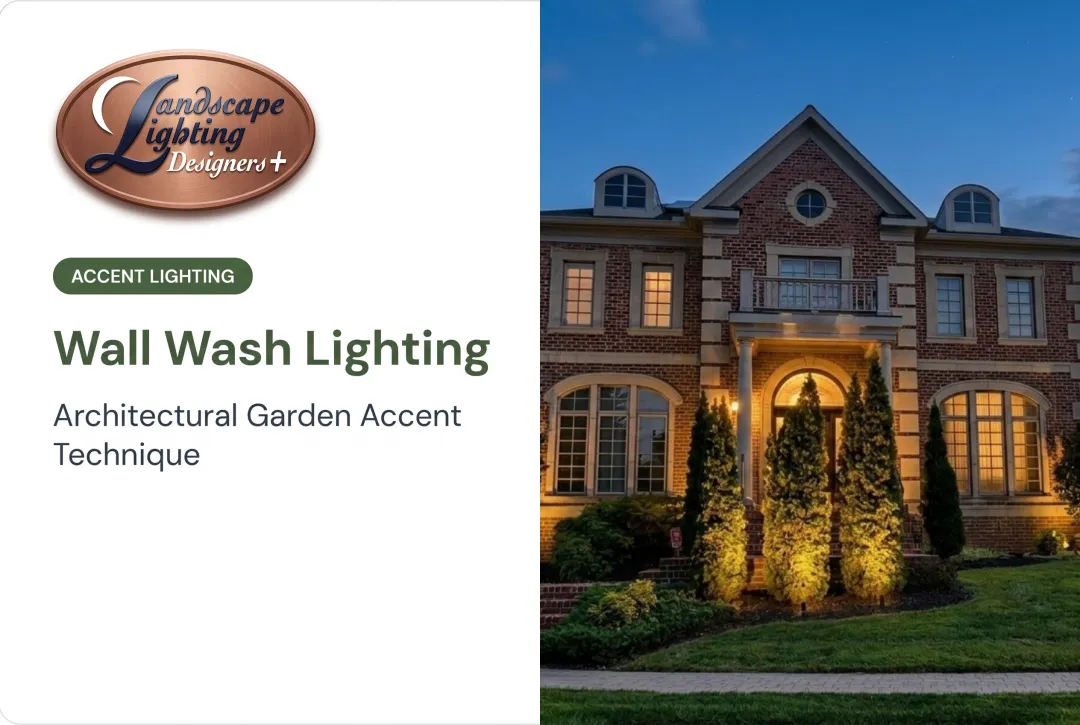
Wall washing is one of the most effective techniques for boosting curb appeal, improving nighttime safety, and showcasing architectural character, whether you own a historic row house in Capitol Hill or a modern build in Rockville. This guide breaks down what wall washing actually is, how it differs from grazing and accent lighting, where to place fixtures, what it costs, and how to choose the right approach for your home.
Key Takeaways
- Wall wash lighting evenly illuminates an entire facade, eliminating shadows rather than emphasizing texture.
- Fixture distance and beam angle from the wall determine whether you get smooth coverage or harsh hot spots.
- Low-voltage (12V/24V) LED systems are the safer, more efficient standard for residential exteriors.
- Professional design delivers subtle, balanced light instead of an over-lit "spotlighted" look.
What Is Wall Wash Lighting and Why Use It on Exteriors
Wall wash lighting uses broad, indirect light sources positioned at a set distance from a wall to create smooth, even illumination from top to bottom. Unlike a narrow spotlight aimed at one feature, a wash covers the entire vertical surface with consistent brightness.
Outdoors, the goal is simple: eliminate harsh shadows and soften imperfections while drawing the eye to a full facade rather than a single detail. This matters most on flat or painted surfaces, garage exteriors, and long expanses of siding where a patchy, uneven glow would look unfinished.
That even coverage pays off in curb appeal, too. According to the National Association of REALTORS' Remodeling Impact Report, 97% of REALTORS consider curb appeal important in attracting buyers, and 98% say it matters to potential buyers themselves. A well-lit exterior at night is part of that first impression.
Common Outdoor Applications
Homeowners typically use wall washing on:
- Brick and stone facades to create a cohesive nighttime silhouette
- Retaining walls that would otherwise disappear into darkness
- Garage exteriors and long fence runs
- Multi-story walls where uneven lighting would look jarring
Beyond aesthetics, a consistently lit facade improves safety and security. Instead of pockets of shadow where someone could linger unseen, a washed wall provides steady, predictable ambient coverage across the whole surface.
That full-surface approach also flatters DC-area architecture. Federal-style townhomes, Victorian facades, and classic row houses carry full-width details—cornices, brick banding, and symmetrical windows—that read far better under an even wash than under isolated spotlights.

Wall Wash vs. Wall Grazing vs. Accent Lighting vs. Uplighting
These four terms get mixed up constantly, and choosing the wrong one is the fastest way to end up with an oddly lit house. Here's how they actually differ.
Wall washing places fixtures farther from the wall with a wider beam, producing a smooth, uniform glow. It works best on flat or painted surfaces where you want an even field of light rather than dramatic shadow play.
Wall grazing does the opposite: fixtures sit close to the wall at a steep angle with a narrow beam. This raking light catches every ridge and groove, making it the go-to for textured stone, stucco, or exposed brick.
Accent lighting isn't about a surface at all. It's a narrow-beam technique aimed at one object—such as a specimen tree, a statue, or an architectural detail— rather than illuminating an entire wall.
Uplighting describes the light's direction, not necessarily its spread. A fixture at the base aimed upward can be used within either a wash or graze setup to add height and drama.
| Technique | Fixture Distance | Beam Width | Best For |
|---|---|---|---|
| Wall Wash | Farther from wall | Wide | Flat, painted, or smooth siding |
| Wall Graze | Close to wall | Narrow | Textured stone, brick, stucco |
| Accent | Varies | Narrow | Single focal objects |
| Uplighting | At base | Varies | Adding vertical drama to either technique |
Choosing wrong here causes real problems. Graze a smooth painted wall and you'll see every seam and imperfection exaggerated. Wash a heavily textured stone facade and you'll flatten out the depth that makes it interesting in the first place. Match the technique to each surface, and walk the property before you lock in a layout—one method rarely fits every elevation.

Photographs settle this faster than descriptions—our lighting project gallery shows how these effects look after dark on finished homes.
Getting the Placement Right: Distance, Angle, and Fixture Types
Placement is where most DIY wall wash attempts fall apart. The right distance depends on wall height, fixture beam angle, and how much coverage you need.
General guidance:
- Grazing typically sits 1-3 feet from the wall
- Washing typically requires 3+ feet of distance for the beam to spread evenly
- Taller walls need either greater fixture distance or multiple staggered fixtures for even top-to-bottom coverage
Beam spread and mounting height work together. A narrow 10-degree beam might be right for highlighting the peak of a gable, while a wide 60-degree beam suits a broad, flat expanse. Get the ratio wrong and you end up with scalloped light—those distracting bright arcs separated by dark gaps along a long facade.
Fixture Types for Wall Washing
Common outdoor wall wash fixtures include:
- In-ground well lights for flush, discreet installation
- Surface-mounted spotlights for adjustable aiming
- Linear low-voltage LED bars for continuous, even coverage along long walls
Low-voltage systems (12V/24V) are the residential standard, and for good reason. This Old House notes that these systems carry lower shock risk, cost less to install and run, and are far easier to adjust than 120V house-mounted units. Craig Collins at Landscape Lighting Designers Plus works exclusively with low-voltage fixtures for exactly this reason: safety without sacrificing effect.
A professional lighting plan avoids classic DIY mistakes—glare, uneven brightness, and hot spots—that show up when fixtures are eyeballed into place rather than calculated. Spacing and staggering multiple fixtures evenly along a long facade is the difference between a polished result and a patchy one.

Cost of Outdoor Wall Wash Lighting
Pricing varies more than most homeowners expect, largely because wall length, fixture count, and wiring complexity all shift the total.
General benchmarks from industry data:
- Per-fixture wall wash lights: roughly $150-$400 each, according to Angi's landscape lighting cost data
- Broader landscape lighting projects average $3,500, with most homeowners spending $2,000-$6,000
- Small, basic setups can run as low as $800; large custom installations can reach $10,000+
What drives the range on a given property:
- Wall length — longer facades need more fixtures for even coverage
- Fixture quality — well lights and linear LED bars cost more than basic spotlights
- Trenching and wiring — running low-voltage cable to remote walls adds labor
- Access difficulty — slopes, hardscaping, or tight side yards increase installation time
Real-world numbers from the DC metro area tend to track with this. A focused entry system might run around $3,000, while a full-property design with wall washing, pathway lighting, and accent work can reach $15,000 or more.

That range is why a property-specific quote beats any national average. Landscape Lighting Designers Plus offers a complimentary design consultation: Craig walks the property, discusses your goals, and prices the work for your facade rather than a generic estimate.
Choosing the Right Approach for Your Home
DIY wall wash kits can work fine on a small, simple wall, a single-story garage face, say. But once you're dealing with a taller facade, mixed materials, or architectural detail worth highlighting, generic kits usually lack the photometric precision to avoid hot spots and dark gaps. This is where an experienced, artistically-minded low-voltage specialist earns their fee. Rather than applying a templated layout, a good designer treats each wall as its own problem to solve:
- What's the wall's texture and material?
- Where does the architecture actually deserve emphasis?
- How does the wash interact with pathway and accent lighting already on the property? Craig Collins has spent 21+ years answering exactly these questions for homeowners across Bethesda, Potomac, Chevy Chase, and neighborhoods throughout Washington DC. His work spans Federal-style townhomes in Georgetown, Victorian and Edwardian homes on Capitol Hill, classic row houses, and brick colonials in Chevy Chase. On those facades, getting the light wrong is obvious, and getting it right is transformative. One homeowner put it simply: their house looked genuinely beautiful at night for the first time in 16 years. That is what balanced, personally designed wall wash lighting delivers. Not a blast of brightness, but a facade that finally reads clearly after dark. Craig personally handles every project (no project managers, no sales reps) and offers a complimentary design consultation to assess your property before recommending a single fixture.
And if you would rather judge the effect on your own property before committing, we can show you your home at night.
Frequently Asked Questions
How much is a wall washer light?
Outdoor wall wash fixtures generally run $150–$400 each. Total project cost still depends on wall size, fixture count, and wiring, so a professional quote is the only reliable number for your property.
What are wall washing lighting techniques?
Common outdoor techniques include washing for even coverage, grazing to reveal texture, accent lighting for a single focal point, and uplighting from the base. These are often combined on the same facade.
How far should a wall wash light be from the wall?
Distance depends on beam angle and wall height, but wash lighting generally sits farther from the wall than grazing does. Professional photometric planning determines the exact spacing needed for even, hot-spot-free coverage.
What is the difference between wall wash and accent lighting?
Wall washing illuminates an entire surface evenly from top to bottom. Accent lighting instead highlights one specific focal object, like a tree or statue, rather than a full wall.
What is the difference between wall washing and wall grazing lighting?
Wall washing uses fixtures farther from the wall with a wide beam for smooth, even light, ideal for flat surfaces. Wall grazing uses fixtures close to the wall at a steep angle to emphasize texture on materials like stone or brick.
What is the difference between an uplight and a wash light?
Uplighting refers to the light's direction, coming from a fixture at the base pointed upward. Wash lighting refers to the light's distribution, an even spread across a surface. The two can be combined in the same setup.