Introduction
Walk down any street in Chevy Chase or Bethesda after dark, and you'll notice something: some homes glow with intention, while others sit in flat, uneven shadow. The difference usually comes down to two techniques — uplighting and downlighting.
Many homeowners struggle with choosing between them, or worse, end up with an unbalanced mix that washes out a beautiful facade or leaves a walkway dangerously dark. Get it wrong, and you risk harsh glare on a historic brick townhome or a security gap near mature trees and entry points.
This guide breaks down what uplighting and downlighting actually do, where each one belongs, and how professional lighting designers layer both for a result that looks natural instead of installed.
Key Takeaways
- Uplighting places fixtures at ground level to dramatize trees, columns, and architectural features
- Downlighting mounts fixtures higher to mimic moonlight and softly illuminate walkways and patios
- The strongest landscape lighting designs layer both techniques instead of relying on one alone
- Architecture, safety needs, and mood determine which technique leads on your property
Uplighting vs Downlighting: Quick Comparison
Before digging into the details, here's how the two techniques stack up side by side:
| Factor | Uplighting | Downlighting |
|---|---|---|
| Light Direction & Placement | Fixtures sit at or below grade, aimed upward | Fixtures mount higher (in trees, on eaves, on pergolas), aimed downward |
| Primary Visual Effect | Dramatic contrast and shadow play; creates a focal point | Soft, ambient "moonlighting" glow that mimics natural moonlight |
| Best Applications | Trees, columns, facades, stone walls, statuary | Walkways, patios, pool decks, planting beds |
| Common Fixture Types | Stake-mounted spotlights, in-ground well lights, bullet spotlights | Tree-mounted moonlights, elevated accent fixtures |
| Security & Safety Role | Illuminates entry points, eliminates hiding spots near the house | Improves ground-level visibility, reduces trip hazards on paths |
| Installation Considerations | Ground mounting, direct-bury cable, service access at grade | Tree-mount junction boxes, growth clearance, concealed vertical wiring |
Neither column is the "right" answer on its own. Most well-designed properties pull from both.
What Is Uplighting?
Uplighting means placing a fixture at ground level or slightly below grade and directing the beam upward. It's one of the oldest tricks in residential landscape lighting. Done well, it builds drama and vertical interest on features that would otherwise disappear after sunset.
For DC-area homes with brick facades, mature oaks, and stone columns, uplighting turns flat daytime architecture into a layered nighttime facade with real depth.
Core benefits of uplighting:
- Creates shadow play and contrast against columns, trunks, and stonework
- Adds vertical interest that draws the eye upward, extending the visual boundary of the yard
- Doubles as a subtle security layer by keeping entry points visibly lit
Two fixture styles dominate: stake-mounted spotlights, which are quick to install and easy to reposition, and in-ground well lights, which sit flush with the soil for a cleaner look near flower beds and hardscape edges.
Kichler notes that fixture output should account for tree height, canopy width, and branch obstructions. A young sapling and a mature oak don't take the same light, which is why fixture selection for uplighting starts with the plant or structure you're lighting.
Use Cases of Uplighting
Uplighting fits almost anything that rises from the ground:
- Front facades and brick or stone exteriors
- Mature trees, columns, and flagpoles
- Garden statuary and stone walls
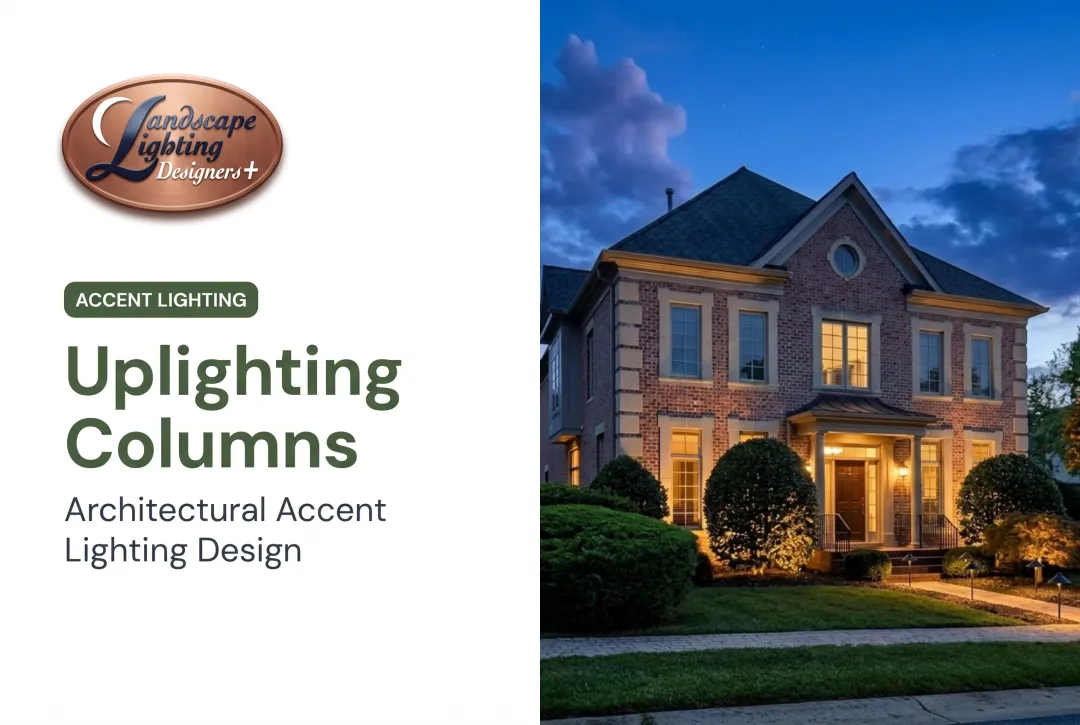
Historic Federal-style townhomes and row houses in Georgetown or Capitol Hill are prime candidates. Uplighting a brick facade or a set of columns brings out texture and proportion that streetlights alone can't touch.
That said, restraint matters. Too many fixtures, or fixtures aimed too bright, can overwhelm a historic facade instead of flattering it. An art-first approach evaluates each column, cornice, and brick line on its own terms, which is why custom design consistently outperforms a generic DIY kit.
Seeing the technique on a finished property makes the decision easier—our project gallery collects completed installations from homes around the DC metro area.
What Is Downlighting?
Downlighting flips the direction. Fixtures mount at height (in tree canopies, on eaves, or under pergolas) and cast light downward. The goal is natural-looking light, not a theatrical effect. Done well, downlighting looks like moonlight filtering through branches, not like a fixture at all.
Core benefits of downlighting:
- Improves nighttime safety on walkways, patios, and steps
- Reduces trip hazards and glare compared to ground-mounted fixtures aimed at eye level
- Creates a calm, inviting ambiance for evening entertaining
The signature version is moonlighting: a fixture high in a tree, aimed down through the branches so leaf shadows fall naturally across the lawn. Kichler's tree lighting guide covers this tall-tree setup and notes that uplighting and downlighting can share the same tree for added depth.
Use Cases of Downlighting
Downlighting earns its place wherever broad, even coverage matters more than a single dramatic highlight:
- Driveways and walkways
- Patios and pool decks
- Planting beds that need gentle fill light
Suburban DC-metro properties with heavy tree canopies (wooded lots in Potomac or parts of Bethesda, for example) often use tree-mounted moonlighting to bathe a backyard entertaining area in soft light without a visible fixture. Evenly lit paths matter for safety as well as looks. The CPSC home safety checklist lists good exterior lighting as one way to help prevent falls.
Uplighting vs Downlighting: Which One Is Right for Your Home?
The decision usually comes down to four factors:
- Architectural style — Federal townhomes and stone facades favor uplighting; wooded lots favor downlighting
- Mature landscaping — Large canopy trees often support both techniques on the same trunk, layered for depth
- Safety priorities — Walkways and steps lean toward downlighting; entry points benefit from uplighting
- Desired mood — Dramatic, bold looks favor uplighting; subtle, natural looks favor downlighting
Choose uplighting to make a statement out of a tree, a column, or a facade. Choose downlighting when the goal is functional, evenly-lit walkways and patios.
Most professionally designed landscapes use both. Balancing brightness, beam angle, and fixture placement across the property is what turns a few exterior lights into a cohesive nighttime design.
Real-World Example: Layering Uplighting & Downlighting in the DC Metro Area
A recurring challenge Craig Collins sees across Bethesda, Potomac, and Chevy Chase properties: striking mature trees and handsome columns, paired with a front walk that goes almost pitch-black once the sun sets. Beautiful bones, poor nighttime function.
The fix isn't picking one technique over the other. On these projects, Craig typically uplights the key trees and columns to restore the home's architectural presence after dark. He then adds tree-mounted moonlighting over the front walk and patio to keep foot traffic areas safely and softly lit.

The result matches what long-term clients describe in their reviews. Dimitri M., a HomeAdvisor reviewer, put it this way after his project:
"For the first time in 16 years, the house looks beautiful at night and we are no longer shrouded in darkness."
Juan P., an eight-year client, noted the lasting curb appeal impact: "Our nighttime look stands out in the neighborhood in both the front and back."
That's the real lesson. A layered, custom-designed approach consistently outperforms a single-technique install or a boxed fixture kit. The starting point isn't a product order. It's a complimentary, no-obligation design consultation, where Craig personally walks the property and figures out where uplighting and downlighting should each carry the load.
Curious how it would look on your own property? Schedule a free consultation with Landscape Lighting Designers Plus, or call (888) 582-8845.
To evaluate the design on your own house rather than someone else's, we can show you your home at night before any work begins.
Frequently Asked Questions
How much does exterior uplighting typically cost?
Cost depends on fixture count, fixture quality, and property size. HomeAdvisor's 2025 guide places installed uplights in the $100 to $400 range per fixture. A complimentary consultation gets you an accurate quote for your property.
What is the difference between uplighting and downlighting for exterior houses?
Uplighting places fixtures at ground level aimed upward for dramatic emphasis on trees, columns, and facades. Downlighting mounts fixtures higher, aimed downward, for soft, broad illumination over paths and patios.
Where should I place exterior uplighting?
Ideal spots include the base of mature trees, columns, stone walls, and facade corners. Space fixtures to highlight features without creating harsh glare or overlighting the surface.
Can uplighting and downlighting be combined in one landscape design?
Yes. Layering both is standard professional practice. Kichler notes the two techniques can even be used on the same tree for a more dimensional, natural-looking result.
Which technique offers better security lighting: uplighting or downlighting?
Both contribute. Uplighting near entry points removes hiding spots around trees, shrubs, and doorways—an approach the National Crime Prevention Council supports. Downlighting improves visibility along paths and walkways.
What is moonlighting in landscape lighting design?
Moonlighting is a downlighting technique using fixtures mounted high in a tree canopy, aimed downward through the branches to replicate natural moonlight falling on the ground below.