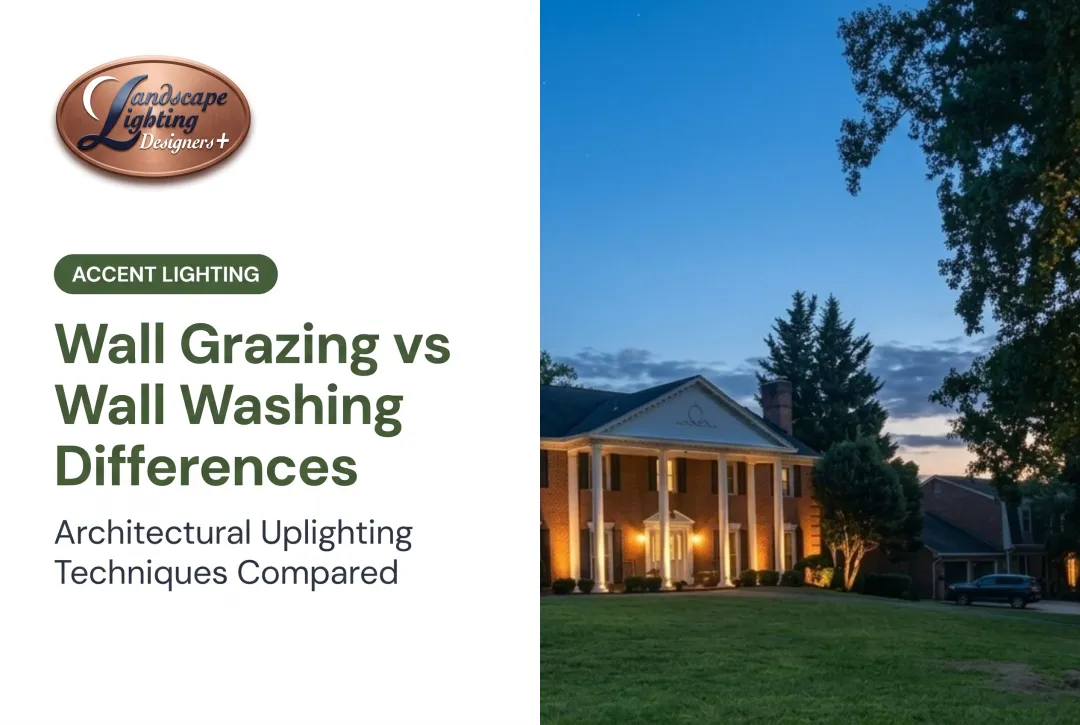
Wall washing creates uniform illumination across exterior walls, highlighting smooth architectural features and dramatically enhancing curb appeal after dark. Unlike scattered ambient light, this intentional technique uses carefully positioned low-voltage fixtures to "paint" walls with light, emphasizing texture, color, and form.
This guide covers everything DC-area homeowners need to know: what wall washing is, how it differs from similar techniques, where to use it, key design considerations, and whether professional installation makes sense for your home.
Key Takeaways:
- Wall washing creates even, shadow-free illumination across smooth vertical surfaces using wide-angle fixtures positioned away from the wall
- The technique differs fundamentally from wall grazing, which emphasizes texture through shadows
- Proper fixture placement, spacing, and color temperature are critical to achieving professional results
- Wall washing works best on smooth surfaces like painted stucco or flat siding, not heavily textured walls
- Professional installation ensures optimal fixture selection and spacing to avoid common pitfalls like hot spots or uneven coverage
What Is Wall Wash Lighting?
Wall wash lighting is a landscape lighting technique that produces uniform, even illumination across a vertical surface from top to bottom, eliminating shadows and highlighting smooth architectural features. The goal is to make the wall itself the focal point, showcasing its color, material, and clean lines without distraction.
The Technical Principle
The technique relies on strategic fixture placement. According to WAC Lighting's landscape guidance, fixtures should be positioned approximately 12 inches minimum from the wall to allow proper light dispersion and avoid harsh shadows.
CAST Lighting similarly recommends starting at around 12 inches and adjusting based on wall height and fixture photometry.
That spacing lets the fixture's wide beam angle (typically 85 to 120 degrees) spread evenly across the surface. The result: smooth, continuous illumination rather than narrow cones of light that create dark gaps between fixtures.

Visual Effect and Purpose
Wall washing delivers a few clear visual payoffs:
- Evenly lit walls make outdoor spaces feel larger and less enclosed, especially in narrow side yards or compact urban settings
- Eliminating shadows draws attention to the wall's surface quality, color, and architectural simplicity
- A uniform glow reads clean and elegant—closer to a museum facade than a high-contrast spotlight look
Why Low-Voltage LED Fixtures?
Professional landscape wall washing typically uses 12-volt LED fixtures rather than standard 120-volt house-mounted lights. Kichler reports that integrated landscape LEDs use up to 70% less electricity than traditional options. Low-voltage systems also offer safer installation, finer control over light output, and easier integration into comprehensive landscape designs.
For DC-area homes, warm white temperatures between 2700K and 3000K work best. These tones complement traditional brick, stone, and painted surfaces common to Federal-style townhomes, Colonial architecture, and historic facades throughout Bethesda, Chevy Chase, Potomac, and Washington neighborhoods.
Wall Washing vs. Wall Grazing: Understanding the Difference
Though often confused, wall washing and wall grazing are opposite techniques, each designed to produce a different visual effect.
The core distinction is simple:
- Wall washing eliminates shadows to highlight smoothness and color
- Wall grazing creates shadows to emphasize texture and dimension
CAST Lighting explains that wall washing should not be used when the goal is to accentuate wall texture, because the technique suppresses detail rather than revealing it.
Technical Differences
The key difference lies in fixture placement:
| Technique | Fixture Distance | Visual Effect | Best Surface Type |
|---|---|---|---|
| Wall Washing | 12+ inches minimum | Even, shadow-free illumination | Smooth painted walls, flat stucco, modern siding |
| Wall Grazing | Under 12 inches | Dramatic shadows that reveal texture | Brick, natural stone, rough masonry |
WAC Lighting notes that grazing placement is no more than 12 inches from the wall, while washing requires greater setback to allow the beam to spread.
Closer placement directs light across the surface at a steep angle, catching every bump, groove, and irregularity. That steep angle works when texture is the design goal. Greater distance allows the beam to spread wider and strike the wall more directly, smoothing out minor imperfections and creating uniform brightness.
Wall washing paints the wall with light evenly. Wall grazing skims light across the surface to reveal dimension.

Decision Framework
Choose wall washing when you want to:
- Showcase smooth finishes and clean architectural lines
- Create a bright, open, welcoming feeling
- Minimize the appearance of minor surface imperfections
- Emphasize the wall's color or material rather than its texture
Choose wall grazing when you want to:
- Highlight natural stone, brick, or textured masonry
- Add depth and drama through shadow play
- Draw attention to three-dimensional architectural details
Benefits of Wall Wash Lighting for Your Home
Enhances Curb Appeal and Nighttime Aesthetics
A beautifully lit facade transforms how your home looks after dark. According to the National Association of Realtors, exterior lighting supports style, ambiance, safety, and curb appeal. A well-lit home feels safer, more welcoming, and more thoughtfully designed.
For DC-area homes where architectural detail matters, wall washing ensures that visitors and passersby see your home at its best, even at night. The technique creates dramatic visual impact without harsh spotlights or uneven illumination that can cheapen a home's appearance.
Creates the Illusion of Space
Evenly lit vertical surfaces make outdoor areas feel larger and more open. This effect is especially valuable for:
- Narrow side yards common in Georgetown or Capitol Hill row houses
- Small front gardens in Chevy Chase or Bethesda neighborhoods
- Compact patios or courtyards where every visual element counts
By pushing light across the full height and width of a wall, the technique eliminates the visual "weight" that dark, shadowy walls create.
Highlights Architectural Features
Wall washing draws attention to beautiful masonry, distinctive exterior materials, and clean modern lines, without the distraction of shadows or dark spots. For homes with smooth painted brick, flat stone facades, or contemporary siding, the technique lets the architecture speak for itself.
Done well, the lighting stays quiet so the architecture reads clearly after dark.

For a full breakdown of what a system like this costs, see our landscape lighting cost guide.
When and Where to Use Wall Washing
Home Exteriors with Smooth Finishes
Wall washing performs best on surfaces where texture is minimal and smoothness is the aesthetic goal:
- Painted stucco – Common in modern and Mediterranean-style homes
- Smooth stone or cast stone – Often found on contemporary homes
- Modern siding – Fiber cement, smooth lap siding, or panel systems
- Flat painted brick – When the goal is to showcase color rather than mortar joints
For DC-area Colonial and Federal-style homes with smooth painted brick facades, wall washing creates a grand, cohesive appearance that emphasizes the home's proportions and symmetry.
Outdoor Living Spaces
Illuminate walls around patios, outdoor kitchens, or seating areas to create bright zones for entertaining after dark. Wall washing turns functional boundary walls into design elements and gives evening gatherings steady ambient light.
Consider washing the walls that frame:
- Outdoor dining areas
- Fire pit seating zones
- Pool decks and spa surrounds
- Covered porches and loggias
Entryways and Facades
Create a strong first impression by washing light across the front wall of your home. This approach is particularly effective for homes with distinctive architectural presence: Federal-style townhomes in Washington, DC, Colonial homes in Bethesda, or brick facades throughout Chevy Chase and Potomac.
The technique provides the visual "welcome" that draws guests from the sidewalk to your front door.
Garden Walls and Privacy Fences
Even light across garden walls and privacy fences turns plain barriers into a backdrop for specimen trees, fountains, or ornamental plantings. That wash adds depth and dimension to the whole yard.
Hiding Imperfections
Wall washing minimizes the appearance of minor surface irregularities (uneven mortar, small cracks, or patched areas) by eliminating the shadows that would otherwise emphasize them. The even distribution of light "flattens" the surface visually, making small flaws disappear.
Key Design Considerations for Wall Wash Lighting
Fixture Spacing and Placement
Proper spacing is critical to avoid scalloping effects: visible arcs of light and dark that create an uneven, amateurish appearance. WAC Lighting recommends fixture spacing at a 1:1 ratio relative to distance from the wall. For example, if fixtures are placed 2 feet from the wall, space them 2 feet apart horizontally.
This guideline applies to fixtures with appropriate wash beam angles. However, exact spacing depends on:
- Wall height
- Fixture lumen output
- Beam spread (wider beams may allow greater spacing)
- Photometric data from the manufacturer
Residential low-voltage wall washers vary widely. For instance, a WAC 12V wall washer uses an asymmetric 50-by-80-degree beam aimed 15 degrees upward, delivering 190 to 980 lumens depending on output setting. The takeaway: Follow the manufacturer's photometric guidance and verify the result on-site. Mock-ups prevent expensive mistakes.

Light Color Temperature Selection
Color temperature shapes how a wall looks at night. Warm white light (2700K-3000K) creates inviting residential ambiance and complements traditional brick, stone, and painted finishes. Cooler temperatures (4000K+) provide crisp, modern effects better suited to contemporary architecture.
For DC-area homes, warm light is the safest choice. Fairfax County requires outdoor architectural and landscape spotlighting to use 3000K or less where covered by ordinance. DarkSky International recommends 2700K or lower for the most night-friendly home lighting.
Balancing with Other Lighting Techniques
Wall washing works best as part of a comprehensive landscape lighting design that includes:
- Path lighting for safe navigation
- Accent lighting for trees, shrubs, and garden features
- Focal-point lighting for entryways, water features, or signature plantings
DarkSky's lighting principles call for light that is useful, targeted, low-level, controlled, and warm-colored. Avoid the temptation to wash every wall. Restraint and subtlety create elegance. A few well-lit walls, layered with path and accent lighting, read as intentional design—not a property flooded with uniform brightness.
Professional Installation vs. DIY
Wall washing principles are straightforward in theory, but achieving professional results requires expertise in fixture selection, precise spacing calculations, and understanding how different wall materials reflect light.
Why Expertise Matters
Fixture selection: CAST Lighting notes that using medium or narrow beams for wall washing can require closer fixture spacing and create hot spots (bright patches surrounded by darker areas). Selecting the wrong fixture wastes money and produces poor results.
Load and voltage planning: Kichler's transformer guide instructs designers to calculate total VA load, stay within transformer capacity, and measure voltage drop for every cable run. Incorrect calculations can cause dim fixtures, flickering, or system failure.
Material reflection: Smooth white stucco reflects far more light than dark painted brick. Experienced designers adjust fixture output and spacing based on surface reflectance. DIYers rarely plan for that difference.
Local Expertise for DC-Area Homes
For homes with historic architecture or distinctive facades, common throughout Bethesda, Chevy Chase, Potomac, and Washington, DC, improper placement can detract from the home's character. Craig Collins at Landscape Lighting Designers Plus brings over 21 years of experience positioning low-voltage fixtures for optimal wall washing effects, particularly on Federal-style townhomes, Colonial homes, and brick facades where balance and restraint matter.
He handles fixture selection and placement on site himself, then tunes the system so light supports the architecture and landscape instead of competing with them.
Safety and Standards
UL Solutions identifies UL 1838 as the Standard for Low Voltage Landscape Lighting Systems. Listed power units are limited to 15VAC or 30VDC output and are evaluated for fire and electric-shock risks. While low-voltage systems are safer than line-voltage work, proper installation still requires knowledge of electrical design, grounding, and code compliance.
AOLP's Certified Low Voltage Lighting Technician credential tests hands-on skills and technical knowledge specifically for 12V systems—a useful benchmark when you want proof of 12V installation skill.
If you want to see how this reads once it is installed, our gallery of completed lighting projects shows the approach on real properties.
Frequently Asked Questions
How far should a wall washer be from the wall?
Wall washers should sit at least 12 inches from the wall so the beam can spread evenly and avoid harsh shadows. Exact distance depends on wall height, fixture beam angle, and desired coverage. Taller walls or wider beam spreads may need more setback.
How close can a light fixture be to a wall?
Fixtures closer than 12 inches create a grazing effect rather than a wash, casting shadows that emphasize texture instead of smoothing it out. For true wall washing, keep at least 12 inches of setback and fine-tune placement using the fixture’s beam specs.
What is the difference between wall washing and wall grazing?
Wall washing eliminates shadows with even illumination, while wall grazing creates shadows to emphasize texture. Placement drives the difference: washing uses 12+ inches of setback; grazing uses 12 inches or less.
What type of walls work best for wall wash lighting?
Smooth, flat surfaces like painted stucco, smooth stone, modern siding, or flat painted brick work best for wall washing. Heavily textured surfaces such as natural stone, rough brick, or deep masonry joints are better suited to wall grazing, which reveals texture through shadow.
Can wall washing be used on outdoor walls and landscapes?
Yes, wall washing is ideal for outdoor applications. It uses low-voltage, weather-resistant fixtures designed specifically for landscape lighting, making it safe and effective for residential exterior walls, garden walls, and privacy fences.
Do I need a professional to install wall wash lighting?
DIY is possible, but a professional helps with fixture selection, spacing that avoids scalloping, safe low-voltage connections, and balance with the rest of your landscape lighting. That attention matters most on architecturally distinctive homes where uneven wash is easy to spot.