Introduction: Why Lighting Is Your First Line of Defense
A Bethesda homeowner returned from a two-week vacation to find her property completely untouched—while three neighbors on the same street had experienced break-ins. The difference? Strategic outdoor lighting that made her home look occupied and exposed, so opportunistic criminals who rely on darkness moved on.
While smart home technology dominates headlines, professionally designed outdoor landscape lighting remains one of the most effective security measures for residential properties. Yet many DC metro homeowners still struggle with the same gap: they invest in cameras and alarms but leave the property dark after sunset, overlooking how lighting drives deterrence, visibility, and safety.
This guide covers both smart lighting technology and professional landscape lighting approaches so you can decide how to protect your property through strategic illumination.
Key Takeaways
- Indoor automation fakes occupancy; outdoor landscape lighting delivers steady visibility coverage
- Placement beats quantity: good design cuts glare and shadows that ruin camera footage
- Low-voltage LED systems use 80–90% less electricity than halogen and run year-round
- Motion zones at side yards and garage approaches deter without harsh floodlights
Understanding Smart Home Lighting for Security
What Smart Lighting Actually Means for Home Security
Smart lighting refers to remotely controlled, programmable LED bulbs and fixtures that connect through Wi-Fi, Bluetooth, or Z-Wave technology. These systems support scheduling, remote control from anywhere with internet access, sensor- or time-based automation, and links to broader security platforms.
GE Cync smart bulbs, for example, support Wi-Fi, Bluetooth, and Matter connectivity with app-based scheduling and remote commands.
Core security features include:
- Scheduling and randomization that mimic normal household activity
- Remote activation when you're away or get a security alert
- Sensor triggers when motion is detected or a door opens
- Voice and app control for a fast response to a possible threat
Crime Prevention Through Environmental Design (CPTED) principles treat lighting as support for mechanical surveillance and territorial awareness. Well-lit properties are harder to approach unseen. Direct head-to-head burglary studies on automated residential lighting remain limited, but the design logic is consistent: remove concealment and you remove opportunity.
How Smart Lighting Creates the Illusion of Occupancy
Brightness helps, but the stronger deterrent is the sense that someone is home. Scheduled lighting patterns simulate normal household routines: living room lights at 7:00 PM, bedroom lights at 10:00 PM, bathroom lights briefly at 11:00 PM, then bedroom lights off by midnight. Randomized scheduling prevents predictable patterns that experienced burglars might recognize during surveillance.
Vacation modes that shift timing slightly each evening avoid the rigid on/off cadence that can signal automation. Pairing lights with other devices adds realism: lights dim when a smart TV turns on, or the porch light responds when a virtual doorbell is pressed.
Motion-Activated Smart Lighting: The Surprise Factor
Unexpected illumination startles and exposes potential intruders who rely on darkness to approach undetected. Outdoors, the goal is simple: light a person clearly at normal approach distances. There is no universal lumen number. Beam spread, mounting height, distance, and surface reflectance matter as much as raw bulb output.
Philips recommends mounting outdoor motion sensors about 5–8 feet high and lowering sensitivity when pets, animals, or passing vehicles cause false triggers. Aim the field at entry points, and keep vegetation, traffic lanes, and heat sources out of the detection zone.
Integration with Security Cameras and Alarm Systems
Proper lighting dramatically improves security camera footage quality, especially at night. Axis Communications emphasizes that scene lighting directly affects camera performance and image quality. Even light across the camera’s field of view matters most. Narrow beams wash out the center and leave edges dark. Bright sources aimed into the lens create glare that hides detail.
Smart integrations include:
- Lights that activate automatically when cameras detect motion
- Coordinated responses when alarm systems are triggered
- Scheduled lighting that matches camera recording schedules
- White LED illumination that complements infrared camera modes
Smart Lighting Limitations for Outdoor Security

Smart bulbs installed in existing outdoor fixtures face practical challenges. Weather exposure, fixture compatibility, and Wi-Fi range issues limit performance. Philips Hue's dedicated outdoor catalog includes fixtures rated IP44 or IP65 for damp and wet locations, but standard indoor smart bulbs placed in non-rated enclosures fail quickly in rain, snow, and temperature extremes.
Additional limitations include:
- Power outages: no power, no deterrence
- Network dependency: if Wi-Fi drops, automation stops
- Coverage gaps: retrofitted fixtures often leave dark spots between locations
- Placement limits: existing boxes restrict where light can actually go without new electrical work
For full exterior coverage, purpose-built outdoor systems—especially low-voltage landscape lighting—usually outperform smart bulbs dropped into existing fixtures. You get more reliable placement, weather-rated hardware, and fewer dark gaps between lights.
How Outdoor Landscape Lighting Enhances Home Security
Outdoor landscape lighting does more than dress up a yard after dark. Used well, it removes hiding spots, supports cameras and neighbors who are watching, and makes approach paths obvious—without turning your home into a floodlit lot.
The Psychology of Well-Lit Properties
Burglars avoid homes where they can be easily seen. The "defensible space" principle holds that consistent ambient lighting eliminates hiding spots and raises the perceived risk for criminals.
CPTED guidance treats lighting as support for mechanical surveillance. Clear, well-lit routes to entries beat concealed approaches every time.
Well-lit properties also signal that someone is home and paying attention. Neighbors and patrol officers can spot unusual activity more easily. DarkSky International notes no clear scientific evidence that more outdoor light alone deters crime. Still, lighting designed for visibility—without glare or deep shadows—serves both security and safety.
Low-Voltage Landscape Lighting: A Dedicated Security Layer
Low-voltage landscape lighting runs at 12 volts instead of standard 120-volt household current. A transformer steps supply down to 12V for landscape fixtures, which lowers shock risk and simplifies install versus line-voltage outdoor circuits.
UL 1838 is the standard for these systems. It covers transformers, fixtures, and wiring built for outdoor exposure.
Advantages for security applications:
- Weather-resistant fixtures and transformers rated for year-round outdoor use
- Flexible placement at entries, pathways, dark corners, and perimeters—not limited to house-mounted locations
- LED efficiency that supports all-night security light at roughly 80–90% less energy than halogen
- Dedicated operation that does not depend on smart-home networks or Wi-Fi

Strategic Illumination vs. Flood Lighting
A single bright floodlight creates harsh shadows, glare that hurts visibility, and a cold, institutional look. DarkSky recommends useful, targeted, low-level, controlled, warm-colored light. For security, that means layered coverage: path lights, accents, and a few spots working together so dark pockets disappear without washing out the property or bothering neighbors.
Professional design weighs:
- Overlapping low-level beams so moving figures stay visible without abrupt bright/dark jumps
- Even light matched to camera fields of view
- Property weak points such as narrow side yards, concealed entries, fence lines, and landscape corners
- Curb appeal so security light improves the home instead of fighting it
Balance and subtlety protect the house without making it look like a parking lot.
Aesthetic Security: Lighting That Protects Without Looking Institutional
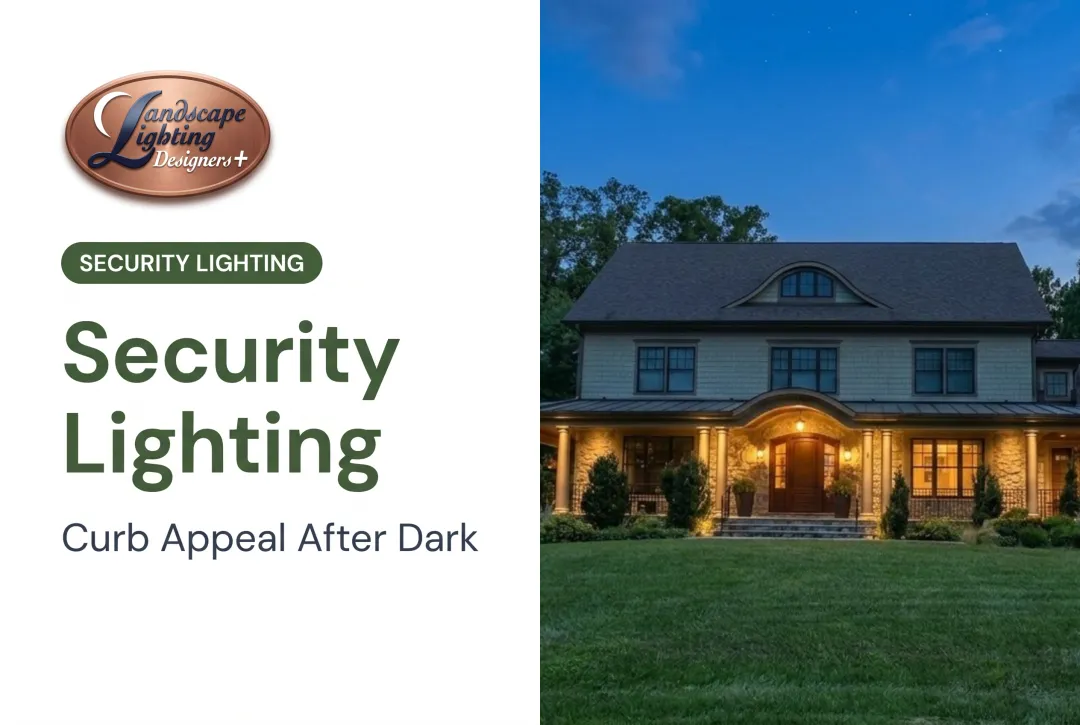
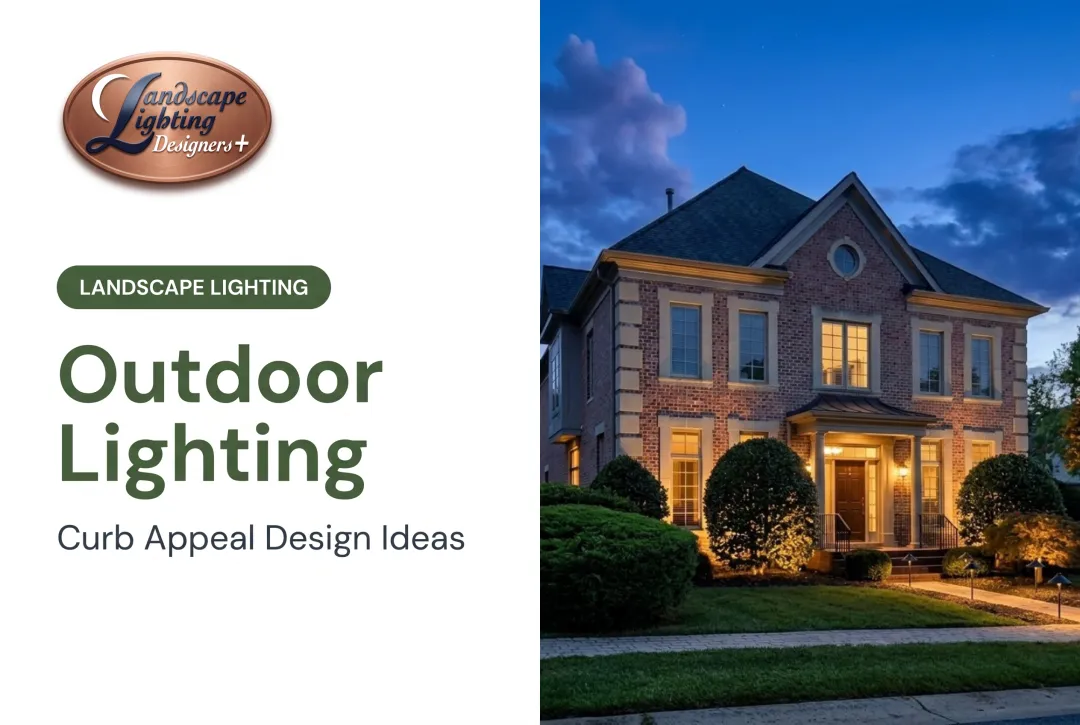
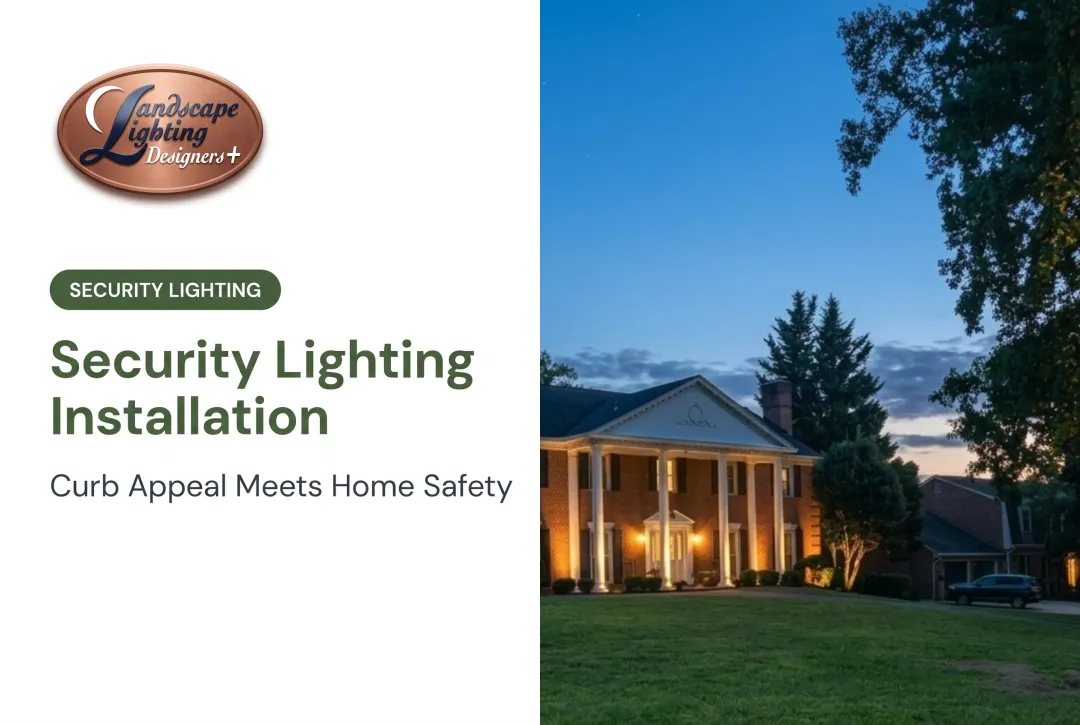
Well-designed landscape lighting improves curb appeal and security at the same time. Warm-white LEDs in the 2700K–3000K range suit the brick, stone, and wood common in DC metro homes. Low-profile fixtures, concealed wiring, and carefully aimed beams keep daytime character intact and change how the property reads at night.
Historic DC homes benefit from the same approach. Federal townhomes in Georgetown, Victorians on Capitol Hill, and row houses in Cleveland Park can take security light that follows the architecture. Uplighting picks up cornices and masonry; pathway fixtures mark stone walks; accent lights frame entries without bulky surface hardware. You meet security goals and still respect preservation rules and neighborhood character.
Landscape Lighting Designers Plus applies this design-first approach across Bethesda, Potomac, Chevy Chase, and Washington neighborhoods—treating lighting as an art form guided by balance, subtlety, and elegance rather than raw brightness.
Strategic Placement: Where Security Lighting Matters Most
Entry Points: Doors, Windows, and First-Floor Access
The most critical zones are front doors, back doors, side doors, garage doors, and accessible first-floor windows. These access points require consistent illumination that reveals anyone approaching while providing safe navigation for residents.
Effective strategies include:
- Front doors: Warm accent fixtures positioned on either side, supplemented by evenly spaced pathway fixtures along the walkway
- Back and side doors: Ambient lighting combined with motion-activated zones for responsive deterrence
- Garage doors and approaches: Pathway or driveway fixtures with motion activation to conserve energy while maintaining security responsiveness
- First-floor windows: Architectural accent techniques using carefully aimed uplights for facades and vertical features

This placement eliminates shadows where intruders could hide while approaching these access points. Low-glare fixtures illuminate the ground plane without shining into visitors' eyes or creating camera white-out.
Dark Corners and Side Yards: Eliminating Hiding Spots
Commonly overlooked vulnerable areas include side yards between houses, areas behind garages, fence lines, and landscaping corners. In urban DC neighborhoods with narrow lots, these spaces are especially challenging. Overlapping low-level beams ensure anyone moving through remains visible without abrupt bright/dark transitions.
Techniques for challenging spaces:
- Side passages: Directional spotlights for architectural details combined with ambient step and rail lighting
- Behind garages and sheds: Motion-activated zones that respond to movement in typically unused areas
- Fence lines and property boundaries: Accent lighting on trees or bollard lights that define edges while providing ambient coverage
- Landscape corners: Uplighting on mature trees creates overhead coverage that spills into surrounding areas
CPTED's clear-view principle applies here: light the routes to entries, preserve sightlines, and avoid landscaping or fixture positions that create concealment.
Pathways and Driveways: Guiding Safe Movement
Illuminated pathways serve dual purposes: safety for residents and a clear deterrent for intruders. Kichler recommends 85–150 lumens per residential path fixture, generally spaced 10–14 feet apart with staggered or alternating placement where suitable. These are manufacturer design guidelines rather than universal standards, but they provide a useful starting point.
Motion-activation options for pathway lighting conserve energy while maintaining security responsiveness. Fixtures turn on when residents approach, guide them safely to the door, then turn off after a preset delay. That on-demand pattern avoids the energy waste of all-night operation while still delivering illumination when it matters.
Perimeter and Boundary Lighting
Defining and illuminating property boundaries adds a security layer, especially in suburban DC metro settings with larger lots. Perimeter lighting creates a visible edge that deters approach from darkened adjacent properties and neighboring yards.
Options include:
- Bollard lights along property lines and driveways
- Well lights recessed into the ground near fence posts or boundary markers
- Tree uplighting that creates ambient coverage across rear yards and side boundaries
Fairfax County requires residential outdoor fixtures to be full-cutoff/horizontal and 3,000K or less, with exceptions for fixtures at 1,500 lumens or less. Motion-activated fixtures at 4,000 lumens or less may also qualify when they turn off within five minutes and stay directed within the property. These rules address light trespass, so keep perimeter lighting on your lot without spilling excessively onto neighbors.

Smart Features vs. Professional Design: What Works Best
When DIY Smart Bulbs Make Sense
Smart bulbs in existing fixtures work well for:
- Interior scheduling in bedrooms, living rooms, and hallways to simulate occupancy
- Remote control and schedules for existing front-porch fixtures
- Indoor security lighting tied to alarms or motion sensors
Cost advantages include low initial investment (individual smart bulbs range from $10–$50), no installation labor, and easy setup through smartphone apps. If you already have outdoor-rated fixtures in the right locations, smart bulbs add automation without new wiring.
The tradeoffs are real. Outdoor fixture compatibility varies, WiFi dependency creates a single point of failure, and you're stuck with existing fixture locations instead of placing light where coverage is weakest.
When Professional Landscape Lighting Is the Better Investment
Professional design becomes essential for:
- Full outdoor coverage: entries, pathways, dark corners, side yards, and perimeters
- Mature landscaping where accent light can double as ambient security coverage
- Historic homes (Federal townhomes, Victorians, row houses) that need low-profile, preservation-friendly fixtures
- Sites where lighting should support existing landscape design, not fight it
You get placement built around architecture, weak spots, and camera sightlines, plus weather-resistant fixtures meant for year-round outdoor use. Longer system life, lower energy use, and stronger curb appeal all support ROI, though returns still depend on property size and local market conditions.
Landscape Lighting Designers Plus has spent 21 years on this kind of work across the DC metro area, including Georgetown row houses, Capitol Hill historic districts, Potomac estates, and Bethesda’s mature landscapes.
The design priority stays the same: balance and subtlety, not institutional brightness.
The Hybrid Approach: Combining Both Systems
Smart indoor lighting and professional outdoor landscape lighting work together for comprehensive security. Indoor smart bulbs simulate occupancy with automated schedules, while dedicated outdoor systems provide continuous visibility coverage around the property perimeter, entries, and vulnerable areas.
Integration possibilities include:
- Driveway motion sensors that turn on indoor living-room lights
- Shared dusk-to-dawn schedules: outdoor landscape lighting on at sunset, indoor bulbs on occupancy patterns
- Alarm-linked responses that fire both indoor and outdoor lights on intrusion alerts
A site walkthrough can map where dedicated outdoor systems are worth it and where smart bulbs are enough, so you spend on coverage that actually closes gaps.
Professional Installation vs. DIY Security Lighting
The Case for Professional Security Lighting Design
A professional consult goes beyond picking fixtures. You get a property vulnerability assessment, fixture placement based on sightlines and access points, code-compliance guidance, and electrical safety built into the plan.
Craig Collins personally evaluates every property across the DC metro area. With 21 years on local homes, he designs around neighborhood-specific challenges and treats lighting as a craft—balanced, subtle, and built to last.
Most projects finish within about a week from contract to final install, depending on property size and system complexity. A typical engagement covers:
- Complimentary on-site consultation
- Custom design matched to architecture and weak spots
- Installation with weather-resistant, low-voltage components
- Follow-up support as landscaping matures or priorities shift
Common DIY Mistakes That Compromise Security
These missteps show up often on DIY installs:
- Insufficient coverage: Dark gaps between fixtures give intruders unlit approach paths
- Poor fixture placement: Shadows hide movement, or glare washes out security cameras
- Wrong brightness: Too much light sparks neighbor complaints; too little fails to show activity
- Indoor-rated gear outdoors: Premature failure from weather exposure
- Voltage drop: Oversized runs or undersized transformers push end-of-line fixtures outside the 9–15V range

DIY mistakes also carry hidden costs: failed fixtures to replace, wasted energy from oversized lamps, and coverage gaps you may only notice after an incident. Low-voltage work is safer than 120V wiring, but professional design is what locks in performance and longevity.
Getting Started: What to Expect from a Consultation
A consult is straightforward. Expect to walk through:
- A grounds assessment that flags vulnerable areas and dark zones
- A short discussion of prior incidents or problem spots after dark
- A design proposal with fixture types and placement
- Scope, timeline, and pricing for installation
Landscape Lighting Designers Plus keeps that process personal: Craig evaluates homes throughout Bethesda, Potomac, Chevy Chase, Rockville, and Washington DC neighborhoods himself.
To get the most from the visit, come ready with:
- A rough budget range
- Notes or photos of areas that feel unsafe at night
- Any HOA or historic-district rules that apply
Consultations are complimentary and no-obligation, and inquiries typically get a response within 24 hours.
Browsing finished work is the quickest way to narrow a direction; our project gallery has installations from across Bethesda, Potomac, and Chevy Chase.
Frequently Asked Questions
Is smart lighting or landscape lighting better for home security?
Each serves a different role. Smart lighting is strongest indoors for schedules, remote control, and occupancy illusions. Professional landscape lighting delivers dedicated outdoor coverage with weather-resistant fixtures and operation that does not depend on Wi-Fi.
Where should outdoor security lighting be placed?
Focus first on entry points: front and back doors, garage doors, and accessible windows. Add pathway and driveway light for safe movement, then cover dark corners, side yards, and property edges so approach routes are not left in shadow.
Do motion-sensor lights really deter burglars?
Sudden light does deter many opportunistic intruders who count on darkness and anonymity. No single residential study pins an exact rate, but Crime Prevention Through Environmental Design (CPTED) and security best practices treat visibility as a core defense layer.
How much does professional security lighting cost?
Costs depend on property size, coverage area, fixture count, and system complexity. Low-voltage LED landscape systems usually cost only a few dollars a month to run in the evening. A personalized consultation gives an accurate project estimate.
Can landscape lighting work with my existing security system?
Yes. Professional systems can work with motion sensors, cameras, and alarms when integration is planned at install. Outdoor sensors can trigger lights, schedules can match camera windows, and alarm events can turn on connected lighting zones.
What's the difference between DIY smart bulbs and professional security lighting?
DIY smart bulbs add automation to fixtures you already have and work best indoors or as a supplement. Professional landscape lighting is designed for outdoor security: weather-rated fixtures, placement based on your property’s weak spots, and reliable operation without a smart-home platform.
Ready to improve your DC metro property’s security and curb appeal? Landscape Lighting Designers Plus offers complimentary, no-obligation consultations in Bethesda, Potomac, Chevy Chase, Rockville, and Washington neighborhoods. Craig Collins personally assesses every property, with 21 years of experience and a design-first approach that favors elegant security lighting over a harsh institutional look. Call (888) 582-8845 or email contact@landscapelightingnow.com to schedule a consultation.